RAÉL HADLEYREVEREND · AUTHOR · THINKER
Menu
← THE BOOKS
Knowledge, faith & uncertainty

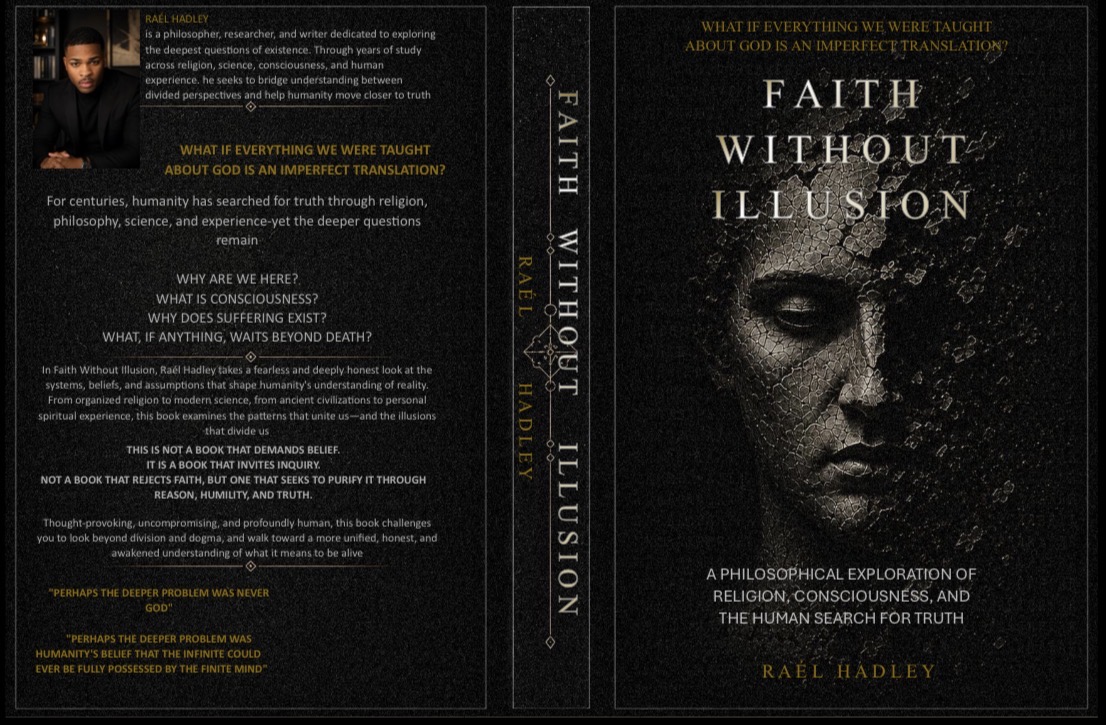
Faith Without Illusion

The God Between Religions

How can finite human beings responsibly make claims about ultimate reality?

Google Books listing ↗
ABOUT THE BOOK

The epistemological foundation

Belief arrives through family, culture, language, and history. Faith Without Illusion examines the human filters through which spiritual truth is received, interpreted, and defended. At its center is Imperfect Transmission Theory: the possibility that something real can be encountered without being perfectly transmitted.

Read the opening

Why This Book Exists I was introduced to certainty before I was introduced to questioning. Before I understood theology, I understood division. Some people inherit religion as tradition. Others inherit it as culture. I inherited it as conflict. I was raised inside a world where belief was not merely spiritual—it was identity, structure, community, discipline, and reality itself. Truth was spoken with certainty. Purpose was defined before questions were fully formed. To doubt was not simply intellectual rebellion; it felt existential, as though uncertainty itself threatened the foundations beneath human life. Later, my world changed. Different environments. Different people. Different religions. Different certainties. I encountered Christianity more deeply after moving to Atlanta, and what struck me was not only how different the systems appeared, but how familiar they felt beneath the surface. The names changed. The language changed. The rituals changed. Yet many of the underlying themes remained strangely consistent: morality, transcendence, accountability, meaning, the soul, the search for God, the search for purpose. That contradiction stayed with me. How could sincere people devote their lives to radically different systems while all claiming access to ultimate truth? Why did disconnected civilizations across history repeatedly reach toward similar spiritual ideas? Why did humanity, separated by

Faith Without Illusion, manuscript p. 7. Transcribed from the supplied manuscript; line breaks normalized.

IN THIS BOOK

Concepts & arguments

Formal concept

Imperfect Transmission Theory

If transcendent reality exists, its communication through human beings is filtered by perception, language, culture, memory, emotion, politics, and time.

Manuscript p. 13
Major argument

The Universality of Belief

Across cultures, people seek transcendence and meaning. Recurrence raises a question about human nature; it does not establish that any particular religious account is true.

Manuscript p. 15
Major argument

Religion, Power, and Human Institutions

Spiritual traditions are carried by institutions that preserve meaning while also accumulating power. The authority of an institution must remain open to moral examination.

Manuscript p. 30
Major argument

Mortality, Meaning, and the Need for God

Awareness of death intensifies the search for meaning. A belief’s consoling function and its truth are separate questions.

Manuscript p. 54
Major argument

The Illusion of Certainty

The feeling of absolute conviction can exceed the grounds that support it. Sincerity and psychological security cannot substitute for justified knowledge.

Manuscript p. 75
Major argument

Faith After Certainty Fractures

Losing an inherited claim to certainty need not end spiritual life. Inquiry can continue through humility, reverence, and responsibility.

Manuscript p. 99
Major argument

The Child Born Into Belief

Belief begins within relationships and communities before a child can assess competing worldviews. Examining that inheritance is different from assuming it is false.

Manuscript p. 121
Major argument

The Geography of God

Where a person is born strongly shapes which religious claims feel natural. This contingency challenges the ease with which people claim exclusive possession of truth.

Manuscript p. 142
Major argument

Spiritual Echoes Across Civilization

Traditions may share recurring spiritual concerns while retaining real disagreements. Similarity invites comparison without flattening differences.

Manuscript p. 165
Major argument

Scripture, Prophets, and Human Interpretation

Sacred communication reaches readers through language, memory, translation, and history. Respect for scripture includes examining the conditions of its interpretation.

Manuscript p. 192
Major argument

The Illusion of Religious Finality

A tradition’s claim to be the final word on ultimate reality must confront the limitations of those making that claim.

Manuscript p. 224
Major argument

The Human Filter

Perception, emotion, memory, culture, and identity shape what people receive and communicate. Human interpretation is never a view from nowhere.

Manuscript p. 246
Major argument

Language and the Barrier of God

Words make spiritual experience shareable, but cannot be assumed to contain the reality they describe. Naming the infinite does not establish mastery of it.

Manuscript p. 273
Major argument

Mysticism, Consciousness, and Spiritual Experience

An experience may be personally profound while its metaphysical explanation remains uncertain. The occurrence of experience and its interpretation deserve separate attention.

Manuscript p. 301
Major argument

Institutions, Dogma, and Corruption

Institutions can preserve wisdom and distort it. When loyalty to a system takes precedence over truth or compassion, spiritual authority becomes vulnerable to corruption.

Manuscript p. 331
Major argument

Why Humanity Continues Searching

The persistence of spiritual inquiry expresses an enduring confrontation with existence, mortality, and meaning. An unanswered question is not automatically an empty one.

Manuscript p. 370
Major argument

Meaning Without Absolute Certainty

Love, responsibility, creativity, and moral action remain meaningful even when ultimate explanations remain unsettled.

Manuscript p. 401
Major argument

Moral Intuition and the Human Soul

Human moral experience invites inquiry into conscience, compassion, and responsibility. Moral seriousness does not require pretending that every question about its origin is settled.

Manuscript p. 426
Major argument

Humility Before the Unknown

Recognizing the limits of knowledge is an intellectual discipline. Humility permits conviction while requiring openness to correction.

Manuscript p. 453
Major argument

The Sacred Beyond Institutions

An institution may mediate spiritual life without owning the sacred. Reverence can outlast disillusionment with human authorities.

Manuscript p. 480
Major argument

Faith Without Illusion

Faith becomes an honest search for truth that does not confuse devotion with certainty or interpretation with final possession.

Manuscript p. 507